



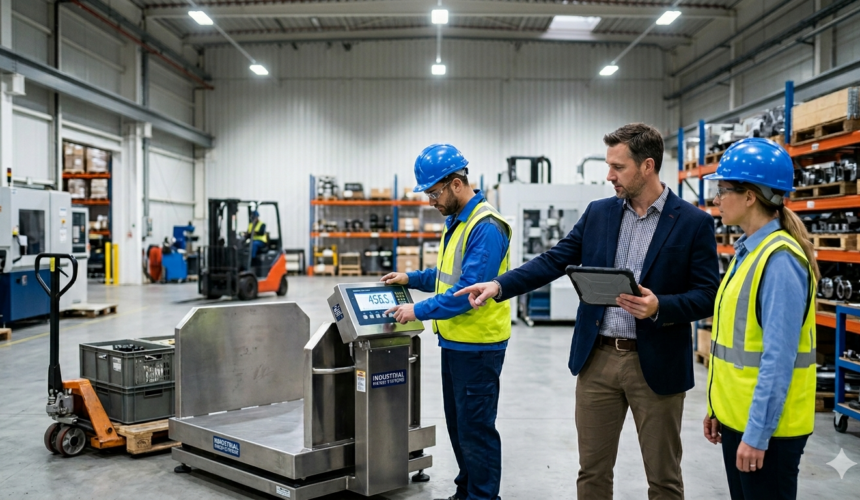
Industrial weighing machines have an important place in more than one industry, from manufacturing and logistics to pharmaceuticals, agriculture, food processing, and warehousing. So choosing the appropriate industrial weighing system supplier can feel like long-term business financing rather than the easiest of small purchasing choices.
With so many manufacturers and suppliers within the market, organizations are regularly caught trying to find a satisfactory answer to their operational desires. Some people are particularly aware of pricing, while others prefer age or perhaps post-income support. Yet the source of the perfect trade weighing system must come down to a balance of several important factors, all at once, not just one.
This booklet will help companies understand how to choose pleasant industrial weighing machine manufacturers and suppliers, keeping in mind long-term reliability and efficiency.
Understanding Industrial Weighing Machines
Industrial weighing machines are specialized machines designed to measure the weight of products, raw materials, cans, engines, or equipment in commercial settings. Unlike primary scales, these machines are designed for heavy exercises, harsher operating conditions, and high levels of accuracy.
Industrial weighing systems are typically used for:
- Inventory Management
- packaging and grouping
- manages quality
- logistics and transportation
- warehouse operations
- Production Line Automation
- compliance and conservation controls
The appearance of the desired smart devices depends entirely on the business application, as well as the load capacity, the environmental conditions, and the workflow actually in progress
Types of Industrial Weighing Machines
First of all, companies planning to buy should know the main types of industrial weighing devices or Industrial weighing scales that are sold in the market.
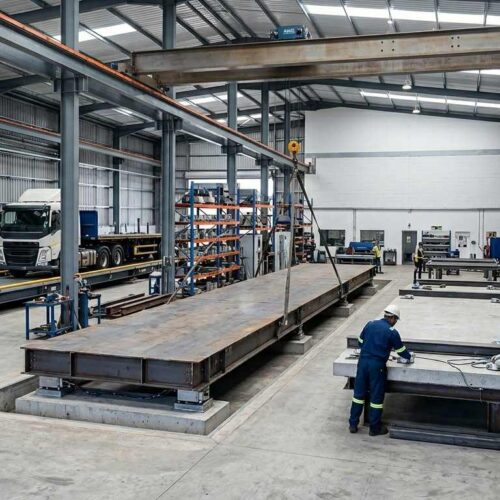
Platform scales can be seen everywhere, in warehouses, logistics centers, and factories, helping weigh huge quantities of goods and heavy materials. Their sizes and capacities can be adjusted to meet industrial needs.
Crane scales are perfect for the type of industries that require weighing of suspended loads like construction, metal fabrication, and shipping.
Bench scales are small and portable, ideal for small industrial operations, packaging, and laboratory applications where precision is important.
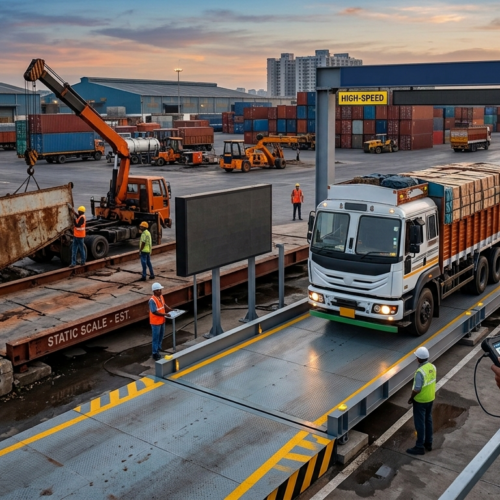
Weighbridges are massive industrial tools capable of weighing trucks and other heavy vehicles. Industries such as mining, cement, agriculture, and logistics greatly depend on weighbridge systems.
Counting scales are very helpful for businesses that need to count parts or components by weight. Commonly these are used in electronics, hardware manufacturing, and inventory management.
Checkweighers are automated weighing stations integrated into production lines to make sure that product weights are at the set target.
Knowing the purpose of use will allow a business to find a supplier that has expertise in the relevant type of equipment.
Why Choosing the Right Manufacturer Matters
Lots of businesses don’t realize how crucial it is to pick the right industrial weighing machine manufacturer. If the machine is of poor quality, it can cause issues like inaccurate measurements, production losses, delays in operations, and even problems with compliance.
A trustworthy manufacturer is not just about a machine. Below are some items they bring to the table:
- Reliable product quality
- Precise calibration
- Leading-edge technology
- Meeting industry standards
- Technical support
- Maintenance services available for a long time
- Ability to customize
Industrial weighing machines are typically worked non-stop for years, so durability and reliability become major factors to consider.
Important Things to Keep in Mind While Getting a Weighing Machine for Industrial Use
In any weighing task, accuracy is a huge factor. Minor discrepancies can sometimes cause money losses, especially for industries that deal with massive amounts of goods.
Organizations should check:
- How calibration is done
- Level of allowable measurement errors
- Whether it meets certification standards
- The quality of the load cell
Usually, those suppliers that are providing certified and tested ones are a safer bet when it comes to operating for years.
There are different models of industrial weighing machines with various weight capacities. A lesser capacity machine can get damaged, on the other hand, a very high capacity one can get you to pay extra without any good reason.
Organizations should figure out:
- What is the average weight of goods?
- What is the highest load expected?
- Will there be a need for bigger loads in the future?
Picking a capacity that fits the needs makes it easier to get better performance out of the machine without affecting its life.
Indoor work environments can be great stress factors for human body and machines as well. The machines can be exposed to:
- Lots of dust
- Humidity
- Measures chemicals
- High temperatures
- The shaking brought about by vibrations
- Significant impact
Top-notch suppliers manufacture with hard-wearing materials such as stainless steel and include corrosion-resistant layers to extend the lifespan of machinery.
In sectors such as food or pharmaceutical manufacturing, hygienic and waterproof equipment designs will be a must.
The industrial weighing systems of nowadays are highly sophisticated. There is a wide assortment of smart features available including:
- Digital readout devices
- Wireless communication capabilities
- Incorporation of data
- Generation of reports without human intervention
- Software for ERP systems
- Monitoring through IoT
If a business is thinking about the next step in automation then they should pick those manufacturers who can provide technologically scalable options.
Every single industry has its own working methods and hence their unique requirements as well. For example, a single company may need to:
- Define the platform’s dimensions
- Perform software integration
- Get industry-specific settings
The majority of the time, it is the manufacturers who understand customer needs and give the option of customization rather than only displaying regular products.
On the other hand, customers such as:
- Chemical plant
- Pharmaceuticals
- Car manufacturing
- Warehousing and distribution
- Food packaging
Their requirements often revolve around getting devices that are unique to their sector and thus they highly value customization.
Most of the time industrial weighing equipment needs to undergo and pass tests in order to prove its compliance with national and international standards. Before purchasing, it is best that the business check if the supplier meets recognized certifications such as:
- ISO certifications
- Legal metrology approvals
- OIML standards
- CE certification
Evaluating Industrial Weighing Machine Suppliers
Before making a decision, firms need to carry out an in-depth investigation of the supplier’s reputation in the market.
Some of the critical factors are:
- Experience in years
- Specialization within the sector
- List of clients
- Ratings and reviews
- Success stories
- Market recognition
Such suppliers that have been around for a long time are very likely to have encountered every possible problem and challenge and thus are better positioned to offer quality and reliable solutions.
Usually, a company that is able to provide a broader variety of weighing equipment will have the capability and resources to meet various industrial requirements.
Furthermore, relying on one supplier whom you trust allows you to simplify the subsequent upgrading and maintenance processes.
Assess Manufacturing Capabilities
It’s worth mentioning that some of the suppliers may not be manufacturers at all but rather distributors or resellers.
Advantages of dealing with direct manufacturers usually include:
- Lower price points
- Prompt customization
- Technical skills and knowledge
- Improved communication
- More reliable warranty handling
Therefore, the business should not hesitate to:
- Inquire about the manufacturing plant and equipment
- Understand the methods of quality control and testing
- Verify how many units can be produced at a given time
- Look at the level of innovation and R&D activities
Request Product Demonstrations
Product demonstrations have become the most successful way for purchasers to get a glimpse of how the product performs in the actual working environment.
While inspecting the equipment, the most important aspects to look at are:
- How easy is the operation?
- Did the display seem big and clear enough?
- Program features and functions
- How fast the system is responding
- Finishing and durability of the product
- Ability to keep performing accurate measurements over time
It is no wonder then that hands-on inspection often unearths functional points that the most attractive brochures don’t disclose.
Analyze Total Cost of Ownership
In the majority of cases, the cheapest price tag does not translate to the best economic choice over time.
Purchasers should put their mind to:
- How much does it cost to set up/install the product?
- Maintenance schedule and frequency
- What will be the calibration cost?
- Will it be energy efficient?
- The price of spare parts
- The expected operational life of the machine
Generally, a high-grade piece of equipment that is robust and long-lasting will be a more cost-effective purchase than a low-priced, less durable one.
Common Mistakes to Avoid
The sole reliance on price-based decisions commonly leads to the acquisition of substandard items, increased maintenance, and decreased lifespan of the equipment.
Instead, businesses should channel their efforts toward maximizing value in the broadest sense rather than simply buying on price.
Typically, businesses purchase weighing systems only for their current operational needs. Yet, future business development could lead to the requirement of larger capacities and more sophisticated automation.
Opting for scalable systems will be a wise investment and a means of preventing costly upgrades later on.
Ignoring the Availability of Service
Basically, even top-notch industrial weighing equipment will need to be serviced at some point. If you decide to go with a vendor that can’t offer you local field service, you might find yourself facing significant operational interruptions.
Using uncertified equipment can make your system fail in compliance audits and may even lead to legal or operational issues.
Make sure to give your first priority to certified and industry-approved equipment.
Industries That Must Use Industrial Weighing Instruments
Industrial weighing machines are a must-have for many industries such as:
Manufacturing
They are utilized to precisely measure raw materials, do batching, and conduct in-process quality control.
The use of these machines is great in controlling freight computations, inventory handling, and ensuring shipping accuracy.
Very necessary for accurate portioning, compliance with packaging requirements, and maintenance of hygiene standards.
Required to achieve exact measurements of ingredients and to stay compliant with regulations.
The machines serve for weighing grains, fertilizers, livestock feed, and the crop yields.
These heavy-duty weighing systems assist in monitoring the movement of raw materials and enhancing overall operational efficiency.
Final Thoughts
Picking the right industrial weighing machine manufacturer and supplier , yeah it’s kind of strategic in a real way. It will touch operational productivity, accuracy, and also longer term business results, whether we notice it fast or not.
Instead of going straight into a purchase just because the pricing looks nice, companies should really look around a bit more… product quality first, and then supplier reputation, certifications, technological abilities , customization options, and the after-sales support side too. Otherwise it can turn into annoying surprises later.
A trusted industrial weighing equipment supplier basically becomes a long-term operational companion . With that, businesses can improve efficiency, stay aligned with compliance requirements and reduce expensive mistakes , the kind that cost time money.
As industries keep shifting toward automation and operations driven by data, investing in dependable, technologically advanced weighing systems will matter even more over time. The organizations that focus on quality, scalability, and a reliable supplier relationship tend to end up with better operational stability and a clearer competitive edge in the market.